On this day of remembrance, forgiveness and hope, I would like to share a Buddha’s blessing that I learned on a beautiful day in October of 2014.
May this poem inspire us to move forward amidst the turmoil present in our world.
“Today, Thursday, October 16, was a beautiful day. I would like to consecrate the beauty of each and every day with one of the prayers we recited, as a group, over the course of the past few days.”
May I see this day through Buddha eyes May I hear this day through Buddha ears May I love this day with a Buddha heart May all I come in contact be awakened to their True Nature
This Irish blessing came to the shore of my consciousness this morning, thinking about humanity’s future.
Perhaps it did come because of Sandra and her husband’s upcoming trip to Erin, the land associated with lush, green landscape and rolling hills, as well as Irish pride.
May the road rise to meet you,
may the wind be always at your back,
may the sun shine warm upon your face,
and the rain fall soft upon your fields,
and until we meet again,
may God hold you in the palm of his hand.
This blessing is often used to bid farewell and wish someone well on their journey, encompassing both physical travel and life’s journey.
This is a prayer for divine protection and guidance until the next encounter.
The phrase “may the road rise to meet you” is a literal translation of the Irish phrase “go n-éirí an bóthar leat,” which can also be understood as “may you succeed on the road,” according to IrishCentral. The blessing’s roots can be traced back to ancient Irish culture and its appreciation for nature and religion.
I want to share an event that made me reflect on the fragility of our (human) life and the concept of fate and destiny—perhaps fate versus destiny.
A young German female athlete lost her life this past Monday, attempting to climb a summit in Pakistan. She was thirty-one years young.
PESHAWAR, Pakistan (AP) — German biathlon champion Laura Dahlmeier has died on a mountain in northern Pakistan after a climbing accident at remote site that rescuers struggled to reach because of bad weather, a local government spokesman said Wednesday.
Laura Dahlmeier had “life smiling at her” after winning many competitions, unchallenged, and becoming an Olympic champion at the age of 24.
Perhaps she had reached the pinnacle of her sports career?
To the effect that she decided, six years ago, to put it behind and retire from biathlon. She became a mountain guide, exploring and conquering summits in various parts of Asia.
Little did she know that this decision would lead to the loss of her life a few years later.
We are at the mercy of the elements, some of them weather- or nature-related, others simply unpredictable, and often unexpectable.
Was it fate or destiny for Laura to make that decision and pursue another life? To take another route?
Knowing she was well aware of the risks inherent in mountain climbing.
Of course, we will never fully know. Yet, through her example and her courage at “bifurcating,” it is worth reflecting on the value of life and its meaning.
Especially when life-as-usual no longer challenges, nourishes or satisfies us.
And honor the memory of an exceptional athlete in the process.
We watched The Theory of Everything a few days ago, a movie about Stephen Hawking’s life. He was a brilliant scientist who spent most of his adult life in a wheelchair, due to a motor neuron disease that struck him while he was attending college.
He fell in love with a lovely woman, Jane, who attended the Church of England. Stephen was a staunch atheist. Toward the end of the movie, as Stephen was in the middle of writing A Brief History of Time, he shared a few lines with Jane.
Then we shall all, philosophers, scientists and just anyone be able to take part in the discussion of the question of why the universe exists.
Who are we? Why are we here? If we ever learn this, it would be the ultimate triumph of human reason, for then we would know the mind of God.
Do you mean this? Asked Jane.
Yes, of course.
So you’re acknowledging him.
These few words got me thinking, especially the “then we would know the mind of God.”
I am no scientist yet, as a rational being, I tend to rely on reason and have a tendency to question what I read or hear.
Hence, the question that promptly came is,
Why would God need a mind?
For one thing, the human mind generates thoughts, sometimes random, sometimes raging like rapids in a river; these thoughts are not always coherent and seldom continuous, jumping from one rock (in the rapids) to the next without any apparent connection.
If God has a mind, then it is more of a ‘continuous mind,’ one that emits and propagates light without ceasing; somewhat similar to what a lighthouse does.
In addition, the Light of God doesn’t discriminate, it shines. Unequivocally.
Where does this take us?
I don’t know; yet I think this differentiation between the human mind and what I would call a God’s attribute is somewhat important.
Answering the question, or at least exploring it, may bring us closer to solving Stephen’s riddle.
Light comes in many forms and shapes, from without and from within.
We may refer to the light of the sun, which blesses us everyday.
And to the fact that the light needs darkness to emerge or manifest.
But does it, really?
As a fire burns in plain daylight, its light is being added or wrapped within light. It is light consumed within light.
When we express compassion for someone or a group of people affected by trauma or disaster, we are sending Light, even invisible light. Yet we know Light has a heartwarming, soothing effect.
It reminds me of the words from the Great Invocation I sent out last week.
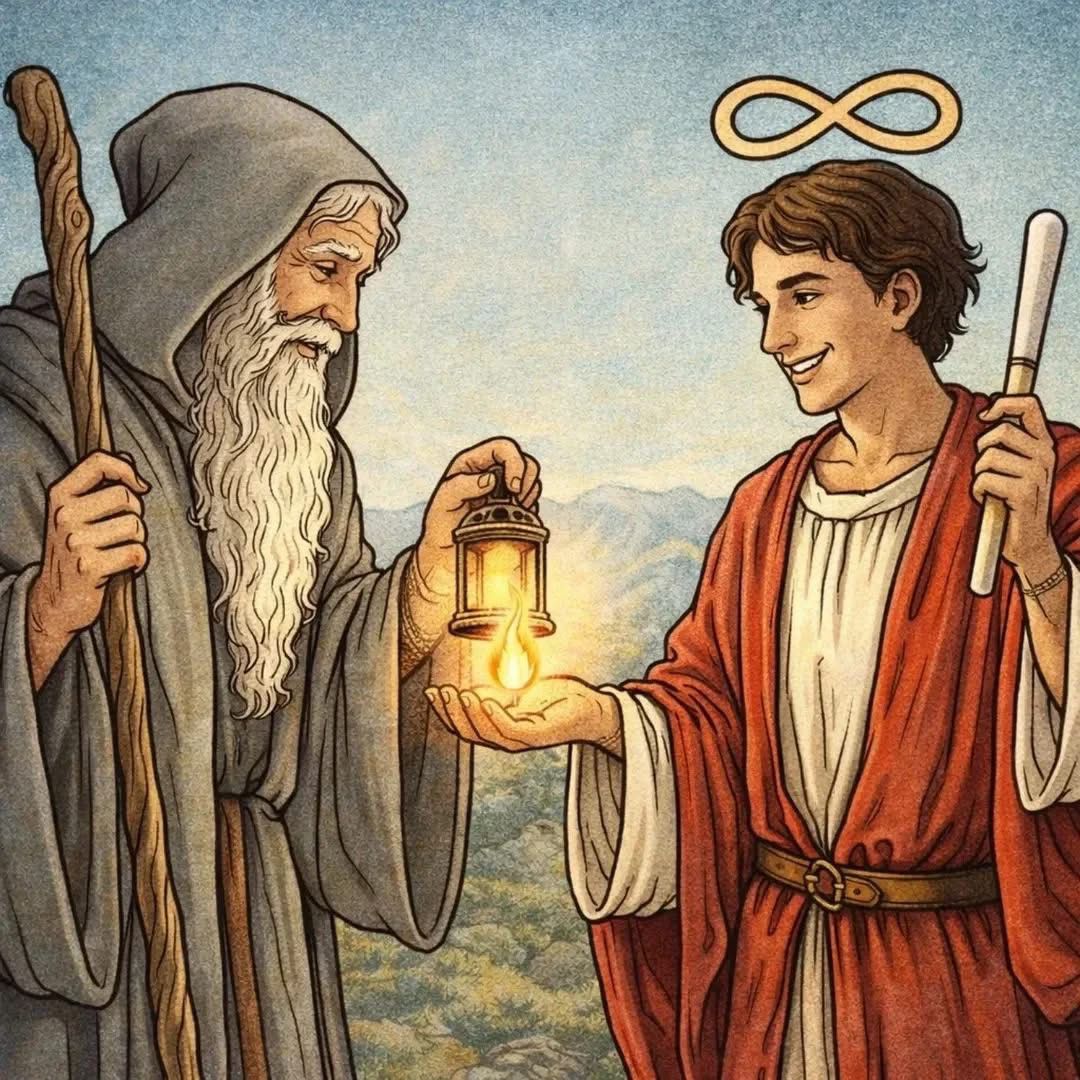
From the point of Light within the mind of God, let light stream forth into human minds.
As I shared last night a verse about the beneficial Light of God, that “cuts men and women free from pain,” a friend offered a poem by Jan Richardson, How the light comes. It was published on December 28, 2021, an uncanny date, I feel.
We can’t really tell how the Light manifests, and what prompts Its emission, yet let’s welcome it into our hearts and minds.
I cannot tell you how the light comes. What I know is that it is more ancient than imagining. That it travels across an astounding expanse to reach us. That it loves searching out what is hidden what is lost what is forgotten or in peril or in pain. That it has a fondness for the body for finding its way toward flesh for tracing the edges of form for shining forth through the eye, the hand, the heart. I cannot tell you how the light comes, but that it does. That it will. That it works its way into the deepest dark that enfolds you, though it may seem long ages in coming or arrive in a shape you did not foresee. And so may we this day turn ourselves toward it. May we lift our faces to let it find us. May we bend our bodies to follow the arc it makes. May we open and open more and open still to the blessed light that comes.
Have you ever experienced a twilight zone? One where it seems difficult to see or make sense of what is coming?
Maria B., a friend of mine who posts now and then, wrote yesterday about the ‘symptoms’ we may be experiencing right now. The Twilight Zone is one of them. No longer in the old (mode of functioning), yet not yet in the new (way of being). Sort of an in-between period of manifestation.
Her words resonated because this is what I have been feeling lately, somewhat “lost” or “dropped” into a time period which is void of meaning—I mean, a concrete meaning that provides grounding and, further down, orientation toward a possible destination.
Maria’s article is entitled, Revelation of Truth and bifurcation of Eras.
I don’t know what kind of Truth is being revealed these days yet I can tell we are bifurcating. Into what, it’s almost impossible to tell; perhaps into the “one road less traveled,” as visionary Scott Peck would say.
What I just found out is that there is a TV series named The Twilight Zone. The first season of The Twilight Zone aired Fridays at 10:00–10:30 pm (EST) on CBS from October 2, 1959, to July 1, 1960. There are 36 episodes, including the pilot, “Where Is Everybody?“
Here is a narration that appeared in most episodes:
“There is a fifth dimension, beyond that which is known to man. It is a dimension as vast as space and as timeless as infinity. It is the middle ground between light and shadow, between science and superstition, and it lies between the pit of man’s fears and the summit of his knowledge. This is the dimension of imagination. It is an area which we call The Twilight Zone.”
As I took a pleasant walk in the park this morning, in what looks like a forest, I thought about what makes the world go round, or the wheel turn. The grease, if you will.
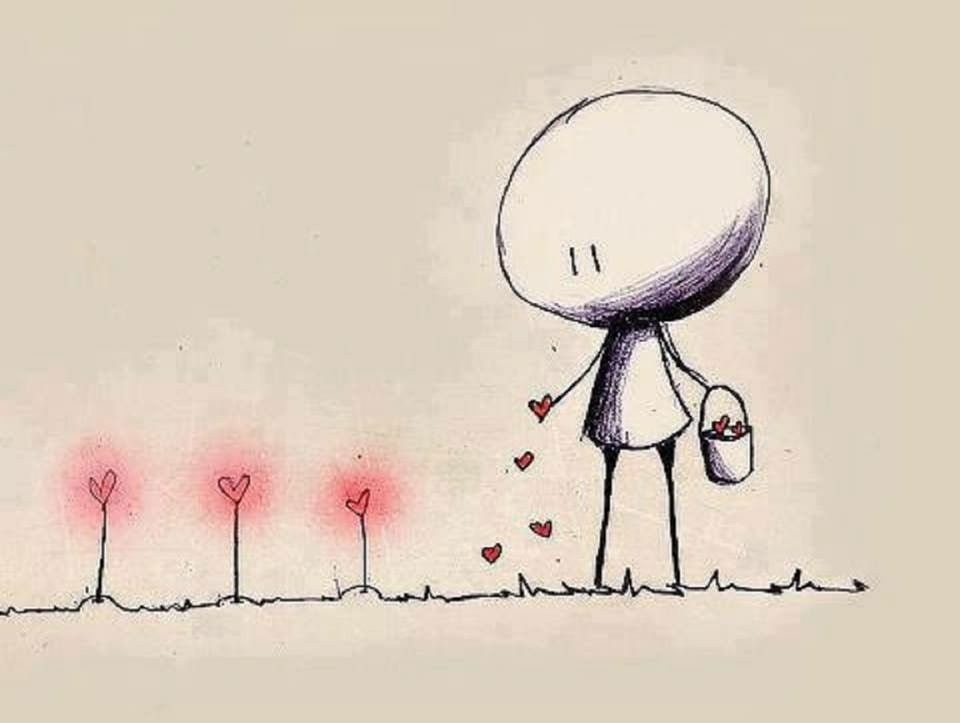
Love is certainly one of these forces, perhaps the most powerful one.
It may work in the background, discreetly in nature, with a sense of perfection and beauty unequaled by humans.
It may influence the way planets and stars dance and mingle in the cosmos, smiling at each other.
Or it could humanely manifest in the way we send energy or resources to the other side of the world to people we will never meet; yet care about them because of their circumstances.
Love is energy, and it is constructive energy.
One that, above all, allows humanity to evolve.
Let’s make good use of Love and let’s spread it all around.
Images of swords have been with me these past days, through the power of (returning) meditations, drawings or messages from friends.
In November of 2016, before I left for France, our son (who was six years old) drew a card for my ailing mother. He drew two swords planted in a rock on the envelope and two knights within the card; a little one, all blue, and an adult knight, with what appeared to be a long orange sword. We sealed the card that evening and I didn’t give it to my mother. I kept it preciously and waited five years and five days before opening it with our son one evening in November of 2021.
Obviously, when talking about the power of swords, one cannot go without alluding to Archangel Michael’s sword. Here is what it says about it.
“Archangel Michael’s sword is a powerful symbol of divine justice, often depicted as a weapon of righteousness, used to combat evil and uphold truth. It represents his role as a warrior and protector, fighting for God’s will and against the forces of darkness. The sword is also seen as a symbol of divine power and authority, capable of cutting through deception and evil.”
Reading this passage brought the following question,
How am I using my sword for the sake of righteousness and justice?
How are we all using our sword at a time when there seems to be so much injustice and un-righteousness in the world?
St. Michael portrayed in the Trinity Dome of the Basilica of the National Shrine of the Immaculate Conception1
What does it mean and how does it get applied, in our every day lives, in our nation states and across the board?
The application of fairness—what each of us deems fair—maybe subjective depending on what goes on and where we stand on many levels or spectrums.
Yet we may agree that the application of fairness shall make the world a better, more equitable, more enjoyable place.
In the process, it shall create more happiness and unity.
Knowing there are plenty of resources all over the world, and yet so many people living in dire poverty, or feeling the scarcity of their situation; with barely a roof to live under.
Applied to self, fairness feels close, very close, to gentleness, even love.
If we want to be fair to ourselves, we shall support ourselves, as well as one another, expecting and trusting the best for everyone, while pulling the darkness or the pain away.
We just passed the landmark of April 1st, the day that marks the beginning of the 2nd quarter of the year.
It is the day when we celebrate or play the Fool!
In the Tarot, the Fool is the first major arcana, numbered 0, represented by a juvenile filled with a sense of adventure, a little white dog as his side and a white rose in his left hand. This young man usually carries a little ‘baluchon’ (bindle) as we say in French.
“The Fool is special to the Tarot deck because the major arcana is sometimes referred to as The Fool’s journey. By starting at the beginning, The Fool travels up the Tarot sequence, experiencing every major event in life before ending the journey with The World…”
While I was well aware of the April Fool’s joke tradition, I never made the connection with the Tarot and even less with the fact that this “Fool Day” might be seen by mystics as a symbolic portal or reset point.
If it is, what could we possibly reset three months into the year?
Please find below the text that Jason D LaBossière posted on Facebook, which inspired my little blurb. Thank you Jason!
• An invitation to embrace the unknown, absurd, or paradoxical aspects of reality and spiritual growth.
• A spiritual trial—will you cling to appearances, or awaken to hidden truths?
Esoteric and Mystical Interpretations
• “Day of the Fool” – In Tarot, the Fool (Card 0) represents a beginning of a spiritual journey, innocence, stepping into the unknown, or divine madness. Mystics might see April 1 as a symbolic portal or reset point.
• Hidden Wisdom in Foolishness – In some mystical traditions (Kabbalah, Hermeticism, Gnosticism), the fool or the trickster figure represents hidden wisdom, a challenge to superficial knowledge or ego. April 1, then, is not empty—but veiled.
• Unwritten Holy Day – Some esoteric thinkers view April 1 as a “silent holy day”, where the absence of official prayer reflects the mystical idea that true wisdom is beyond ritual, and that divine truth may be found in paradox or absurdity.
• Inversion and Reflection – The day could symbolize a mirror or reversal—a test to see who is anchored in illusion vs. deeper awareness. In alchemical or mystical practice, fools are often enlightened souls misunderstood by the world.