What strange terms, dear Ones. I was not familiar with this undragon-thing, and neither did I ever hear the name Eustace. Are you, did you?
The story comes from the book, The Voyage of the Dawn Treader, by British author C. S. Lewis. It is one of the seven books in the Chronicles of Narnia. Why only C. S. and not his full names—Clive Staples—spelled out, that is another mystery.
That being said, the Universe sometimes takes unexpected twists and turns to bring us to where we’re supposed to arrive.
On Sunday, looking into my treasure chest of books, I unearthed one I wasn’t looking for: Awakening the Energies of Love, a book by Ann Hillman that I very much enjoyed devouring during a voyage to the Philippines in 2009.
In chapter 14, Living in the Kingdom while Living in the World, she shares the story of a boy named Eustace that she heard from Don Bisson, a Marist brother, supervisor and trainer of spiritual directors.
The Snake (2) p. 305-306
“Although I wasn’t in town for Don Bisson’s day-long lecture, I listened to his taped words two months later as I drove across San Francisco Bay to care for our newborn granddaughter, Chloe. I was strangely impacted by the C. S. Lewis story he told about a little boy who had been cursed. The way he told it, the boy’s skin had been turned into scales like those of a snake, and every time he tries to tear off a layer of ugly, scaly ‘snake skin,’ another layer appears beneath it. Layer after layer he removes, and still there is always one more underneath. Surely he is cursed. Then the Lion appears to the boy and says, “Let me peel off the last skin for you.”
Bisson says that Lewis considers the Lion a Christ-Consciousness figure and asserts that it is always the Lion who removes the last skin—we cannot do it ourselves. His story goes on to say that when the Lion actually pulls off the last skin, it penetrates deep into the boy’s core and hurts more than the loss of any other layers. The boy suffers terribly. Then the Lion tells him to bathe in a particular well, and although the water stings at first, it soothes and heals him—washes him clean of the debris that had obscured his tender connection with the depths of who he really is. With Being.
Listening to the story, I remember the words of Meister Eckhart:
“A [human being] has many skins in him/herself, covering the depths of his/her heart. Go into your own ground and learn to know yourself there.””
That was enough to titillate my curiosity and my AI companion kindly retraced the full story for me.
“Yes, the story you are referring to is the famous transformation of Eustace Scrubb into a dragon (and his subsequent healing by the lion, Aslan) from C. S. Lewis’s 1952 book, The Voyage of the Dawn Treader, which is the third book published in The Chronicles of Narnia series.
In the chapter titled “The Undragoning of Eustace,” Lewis uses this narrative as a powerful, allegorical illustration of Christian conversion, surrender, and spiritual rebirth—what Ann Hillman and Bisson describe through the lens of accessing “Christ-Consciousness” or connecting with “Being.”
How the Story Unfolds in the Book
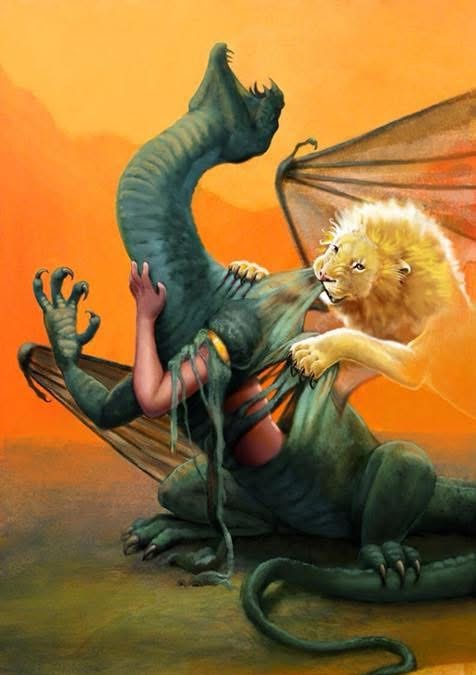
- The Curse: Eustace is a deeply selfish, miserable, and antagonistic boy. While stranded on an island, he sleeps on a dragon’s hoard of gold while harboring greedy, dragonish thoughts. When he wakes up, he discovers he has physically turned into a literal dragon, complete with scales, claws, and a tail—a reflection of his internal state.
- The Realization: Being trapped in a monster’s body breaks Eustace’s harsh exterior. For the first time, he feels lonely, appreciates kindness, and deeply desires to change and rejoin human companionship.
- The Limits of Self-Help: Eustace tries to scratch and peel off his own scaly dragon skin. He manages to peel off three separate layers on his own, but each time he looks down into the water, he finds that he is still a thick, ugly dragon underneath. He realizes his own efforts are entirely useless to save him.
- The Lion’s Intervention: Aslan (the Lion) appears and tells Eustace, “You will have to let me undress you.” Eustace is terrified of the Lion’s sharp claws, but he submits.
- The Deep Wound and Healing: Aslan’s first tear is so deep that Eustace feels as though it went straight to his heart. It causes intense, terrible pain, but it successfully tears away the ultimate, true dragon skin. Aslan then throws Eustace into a large marble bath of pure water. It stings fiercely at first, but it quickly turns into absolute refreshment, washing him completely clean and restoring him into a human boy.
The Significance
Lewis wrote this to show that while self-improvement can change outward behaviors (the first few layers of skin), it cannot change a person’s fundamental nature. The final, deepest transformation requires complete surrender to a higher power (Aslan/Christ), a process that is often painful because it requires tearing away the deeply rooted ego.”
How strange that we need a Lion to un-dragon ourselves!
And yet Ann Hillman writes about the snake—not the dragon. Perhaps a gentler touch!
In real life, the night she heard the story of Eustace, she found a baby snake on her patio!
Topic: The undragoning of Eustace
Time: Oct 15 @ 2:30 PM Eastern Time
Meeting ID: 861 4497 5595